Inside the Pinnacles Desert: The Loop, the Walk and What to Look For
Short answer. There are three routes through the field and they take twenty minutes, an hour and fifteen minutes respectively. Drive the 4.5 km loop first to see the scale, then walk the 1.5 km trail to feel it. Look for the grey caps on top of the pillars and the knobbled root casts in the sand between them, because those two things are the whole story of how the place formed.
What you are actually looking at
A flat plain of yellow sand with thousands of limestone columns standing in it, the tallest up to 4 metres, and nothing else above knee height for kilometres. There is no summit, no single famous rock and no named individual formation. That is not an oversight — it is what the place is, and it changes how you should move through it.
Because there is no one thing to find, you are not ticking off a list. You are picking a direction and looking at what happens when low sun crosses a field of vertical stones. How the pillars formed explains why there is no centrepiece.
The one-way drive, in order
The Pinnacles Desert Drive leaves from the Discovery Centre car park, runs about 4.5 km on sealed road, and returns to where it started. It goes one way only, with parking bays at points along it. Any hire car handles it, and so does a coach.
| Stretch | What changes | Worth stopping? |
|---|---|---|
| The first few hundred metres | Scattered pillars, thin on the ground | No - keep going, it gets denser |
| The middle third | The densest part of the field, pillars on both sides | Yes - this is the section people photograph |
| The lookout | The high point, with the field spread below | Yes - the only place you see the extent of it |
| The return leg | Taller, more isolated columns | Yes - the best single pillars are here |
| The last stretch | Thinning out towards the car park | Only if you missed something |
You cannot go back for a photograph. The loop is one-way, so a pillar you drive past is gone. Stop when you see it, even if it feels early. If you would rather not be governed by that, a private departure can drive the loop twice.
The Desert View Walk Trail
The Desert View Walk runs 1.5 km on foot through the field, and it is the reason to leave the car at all. On the drive the pillars are a landscape; on the walk they are objects, and you finally register that some of them are taller than you by half again. Allow forty-five minutes to an hour.
The surface is soft sand with limestone edges, so wear closed shoes. There is no gradient worth the name and no scrambling. What makes it tiring in summer is that there is no shade at any point on it, which is covered on the safety page.
The 300 m accessible path
The first 300 m of the walk is a Class 1 accessible path to a viewing platform, sealed the whole way. Two accessible parking bays sit about 20 m from the accessible toilets and 140 m from the Discovery Centre.
It is a real view rather than a token one, and combined with the drive it means the field is genuinely reachable without walking on sand. The trails page has all three routes with distances and grades.
What to look for: the grey caps
Many pillars carry a distinctly different-looking crown on top — harder, greyer, often overhanging slightly. That is calcrete, and it is the reason the pillar is there at all. It formed as a lid over softer limestone and protected what was underneath while everything around it was leached away.
Once you have seen one you will see them everywhere, and the pillars stop looking random. The ones with intact caps are tall; the ones whose caps have failed are stumps.
What to look for: the root casts
In the sand between the columns there are low, knobbled shapes that look like broken pipe. Those are rhizoliths — fossilised plant roots, cemented by the same process that made the pillars. They are the first stage of the whole sequence, caught in progress.
They are also fragile, and the park’s own management plan records that some have disappeared completely under visitor pressure. Look at them from the marked route rather than walking out to them.
What the Discovery Centre adds
It sits at the edge of the yellow sand and it is the only building in the desert area. Inside are displays, soundscapes, videos and objects setting out how the pillars formed and what the cultural and natural heritage of the area is. There is a retail gallery, and the only flushing toilets you will find here.
Half an hour in it changes the rest of the visit. You go out looking for calcrete caps and root casts rather than at interesting rocks. The catch is the clock: it closes at 4:30 pm, which is before the light gets good, so it belongs at the start of a daytime visit and is simply not available on an evening one.
Photographing the field
Three things make the difference here and none of them costs anything. Shoot into the low sun rather than with it, because backlighting separates a pale pillar from pale sand and front light merges the two. Get low: kneeling puts the horizon below the pillar tops and gives back the scale a standing shot loses.
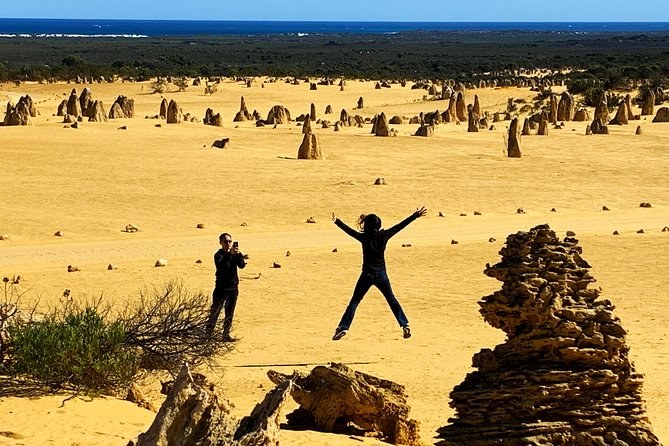
And put a person in the frame at fifty metres. Nothing else in the plain is more than knee high, so a viewer has no way of telling whether a pillar is a metre tall or four without something familiar beside it. The travel tips page has the rest, including which hour to be here in each month.
The order that works
- The Discovery Centre first, if it is open — it closes at 4:30 pm and it explains everything you are about to look at.
- Then the drive, for the scale and to find where the field is densest.
- Then the walk, ideally in the last hour of light.
- Then, if you are staying, the sky — but check what time it goes dark in your month first.
How long each of them takes
Twenty to forty minutes for the drive depending on how often you stop. Forty-five minutes to an hour for the walk. Fifteen minutes for the accessible path. Half an hour for the Discovery Centre. That is about two and a half hours if you do everything, and every guided departure allows between one and two.
The ones that give you longest are the private days, and one of them states in its own listing that you may stay as long as you like. Pinnacles desert stargazing tours show how long each departure allows.
What most visitors miss
Three things. The lookout on the drive, because it comes after most people have already stopped four times. The root casts, because they are at ankle height and everybody is looking up. And the far end of the return leg, where the pillars are most isolated and photograph best against open sand.
Pinnacles Tours lists every departure with how long it allows here, which is the number that decides whether you get all three.
Drive the loop to see the scale, then walk the trail to feel it.Most departures refund in full; each card states its own window.
See the departuresDepartures that give you longest among the pillars
4x4 Pinnacles Desert & Turquoise Coast Small Group Experience
Park fees includedLunch includedMax 5
From $186 per person
Pinnacles & Rottnest Island Scenic Air & Ground Tour
Park fees includedYour group onlyMax 10
From $803 per person