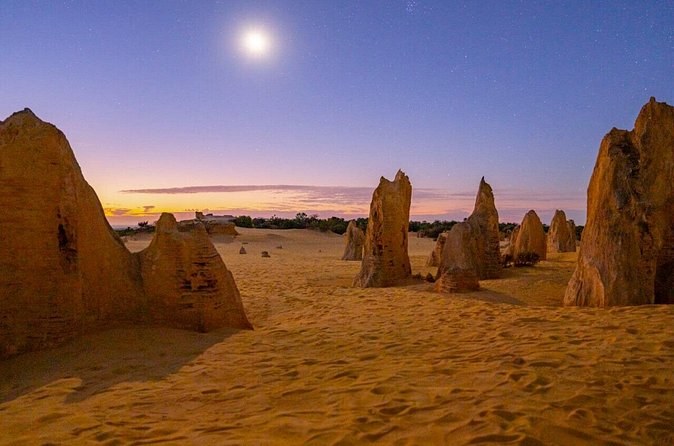
Pinnacles Desert Sunset Stargazing Adventure Tour from Perth
Park fees includedDinner includedTelescope provided
From $127 per person
Three things, and they are all geography. The nearest town is Cervantes, 17 km away and small. The nearest city is Perth, 200 km south. And there is nothing at all in between on the seaward side, so the light dome over the field is close to nothing.
The fourth thing is the foreground. Photographing the Milky Way over flat ground gives you a sky and no picture; photographing it over a plain of limestone columns gives you both. That is why this particular dark sky is worth driving to rather than any dark sky.
This is the table that decides an evening booking, and almost nobody checks it. Sunset is the well-known number. The one that matters is the second column: astronomical twilight ending, which is when the sky is properly black rather than merely dim.
Local time at the Pinnacles, on the 15th of each month.
| Month | Sunset | Fully dark | Usable dark before 9 pm |
|---|---|---|---|
| January | 7:27 pm | 9:00 pm | almost none |
| February | 7:09 pm | 8:33 pm | almost none |
| March | 6:38 pm | 7:58 pm | under an hour |
| April | 6:01 pm | 7:20 pm | about an hour and a half |
| May | 5:34 pm | 6:56 pm | about two hours |
| June | 5:26 pm | 6:51 pm | about two hours |
| July | 5:37 pm | 7:00 pm | about two hours |
| August | 5:55 pm | 7:15 pm | about an hour and a half |
| September | 6:12 pm | 7:31 pm | about an hour and a half |
| October | 6:30 pm | 7:52 pm | under an hour |
| November | 6:55 pm | 8:24 pm | under an hour |
| December | 7:19 pm | 8:55 pm | almost none |
The instinct is that summer is the season for being outdoors at night, and here it is wrong. In January the sun sets at 7:27 pm and the sky is not fully dark until 9:00 pm — the hour visitors are expected to be leaving the park. A January evening departure is a sunset tour with a look at the moon.
In June the sun sets at 5:26 pm and the sky is dark by 6:51 pm, which leaves two clear hours. The nights are colder and July brings 112 mm of rain, so you are trading certainty for opportunity — but when a winter night is clear, it is far better than any summer one.
One of the evening departures publishes its own version of this: the collection time varies through the year so that the tour reaches the desert as the sun drops. That is not marketing, it is the same arithmetic. The pickup on these tours is set against sunset rather than against a clock, which is why two people booking the same product six months apart leave Perth ninety minutes apart.
The southern sky, which for most northern-hemisphere visitors is the point. The Southern Cross and the two Pointers are the obvious ones. The Magellanic Clouds are visible to the naked eye on a properly dark night. And the galactic core — the bright, structured part of the Milky Way — rides high on southern autumn and winter nights, which is the same half of the year that gives the earliest dark.
Those two things lining up is the argument for a winter visit in one sentence.
| Departure | What it carries | Meal |
|---|---|---|
| Sunset dinner and stargazing | Mobile observatory and astro-binoculars for deep-space observation | Dinner cooked in the desert |
| Sunset stargazing adventure | Telescope, and all park fees inside the fare | Dinner |
| Sunset stargazing dinner, small group | Telescope, plus a guided walk in the park | Dinner under the stars with a glass of wine |
| Sunset and night-time stargazing | Two separate visits to the field, one in daylight and one after dark | Afternoon tea and dinner |
All four are on the stargazing departures page with fares, group caps and pickup points.
More than during the day. At the desert in daylight there is nothing to find and no way to get lost, so a guide adds context rather than access. Under a southern sky that most visitors have never seen, being shown what you are looking at is the entire difference between a nice night and an interesting one.
The reviews bear this out: travellers name the guide who ran the telescope far more often than they name anything else about the evening.
It is the one risk nobody controls and the most common complaint on every evening departure here. One traveller describes paying a full fare and seeing neither the sunset nor the stars. Another was messaged in advance and asked whether they wanted to move the booking by two days because the forecast was poor; they moved it, and the night was clear.
That second story is the strategy. Almost every departure here refunds in full at twenty-four hours’ notice, so book the date you want, watch the forecast, and move if it turns. Winter is the darkest and also the cloudiest half of the year, which makes the refund window more useful, not less.
Three things beyond the usual. Use the pillars: a Milky Way frame with a limestone column in it is a photograph, and one without is a star chart. Get there before dark so you can choose your foreground while you can still see it. And bring a torch you can dim — the field is genuinely dark and the sand is uneven.
The travel tips page has the daytime photography advice, which is a different problem entirely.
Entirely possible and reasonably common. The desert is visitable after the Discovery Centre shuts, entry is A$17 a vehicle, and you are expected out by 9 pm. What you take on is a 200-kilometre drive home in the dark on a road where kangaroos and emus are active at dusk, after a long day.
If you are staying in Cervantes rather than driving back to Perth, this is the best option available and it costs almost nothing. If you are going home to Perth, Pinnacles day tours from Perth exist precisely so that somebody else does that last two hours.
An evening in the field is colder than a day in it by a wide margin, and that is the thing travellers most often wish they had prepared for. July overnight minimums average 9.5 °C on the coast before you allow for wind, and the field is open sand with nothing to break it.
Worth checking alongside the month, because a full moon over the field is bright enough to read by and will wash out everything faint. If the Milky Way is what you came for, look for a date within a few days either side of new moon.
The opposite is also true and less often said: a moonlit night is the better one for photographing the pillars, because the moon lights them and the stars still show. If the stone rather than the sky is your subject, a half moon is close to ideal. None of the guided departures schedules around the moon, so this is entirely your call when you pick a date.
If you are staying 17 km away rather than driving back to Perth, the calculation changes completely. You can be in the field for full dark, stay until the 9 pm expectation, and be back at your accommodation twenty minutes later rather than two hours later. Park entry is A$17 for the vehicle and you can do it on consecutive nights if the first is cloudy.
That is the best way to see this sky and almost nobody does it, because the town is small and the tours all run out of Perth. The drive-yourself comparison has the rest of the arithmetic.
April to September if the sky is the point, with June and July the best of them for darkness and the worst for cloud. October and March are the compromise. December, January and February are for the sunset, and there is nothing wrong with that — just book them knowing what you are getting. Pinnacles Tours sets out which departures carry a telescope and which do not.
From $127 per person
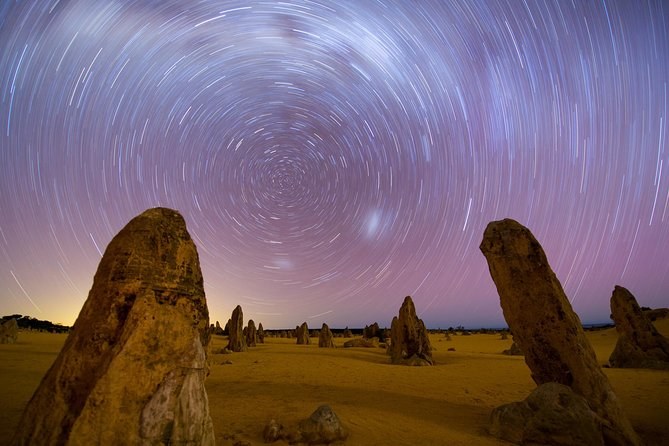
From $145 per person
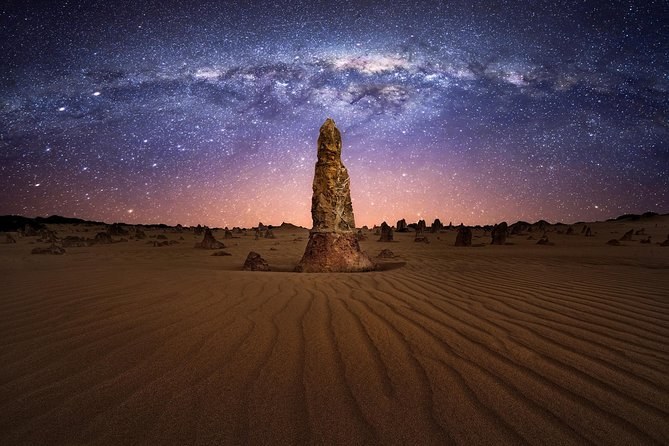
From $182 per person