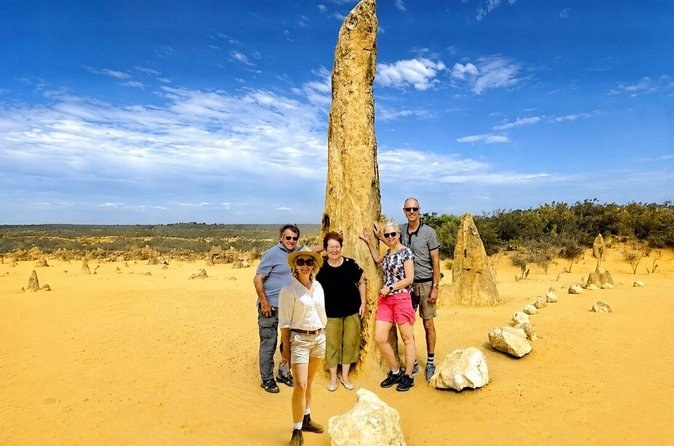
4x4 Pinnacles Desert & Turquoise Coast Small Group Experience
Park fees includedLunch includedMax 5
From $186 per person
Not the desert itself. The sand plain immediately around the columns is bare, and it stays bare — that is what a field of exposed limestone in moving sand looks like. What flowers is the low heath surrounding the desert area and lining the road in: acacia and myrtle scrub, with tuart woodland in the valleys.
The park authority describes that vegetation bursting into flower from august to october and calls it a memorable spectacle. In practice you see most of it from the road and from the edges of the car park rather than among the pillars.
Western Australia’s south-west has a Mediterranean climate: wet winters, dry summers. The rain falls between May and August — 74 mm, 106 mm, 112 mm and 82 mm at the nearest coastal station — and the heath responds once the temperature starts to climb again.
That puts the flowering after the wet and before the heat, which is exactly the gap that makes those three months good for everything else too.
Coastal figures from Jurien Bay (Bureau of Meteorology station 009131), 50 km north; dark computed for the desert.
| Month | Avg max | Rainfall | Fully dark | Flowering |
|---|---|---|---|---|
| January | 30.1 °C | 7.3 mm | 9:00 pm | No |
| February | 30.8 °C | 15.4 mm | 8:33 pm | No |
| March | 29.5 °C | 14.8 mm | 7:58 pm | No |
| April | 26.4 °C | 29.1 mm | 7:20 pm | No |
| May | 23.4 °C | 74.1 mm | 6:56 pm | No |
| June | 20.6 °C | 105.7 mm | 6:51 pm | No |
| July | 19.6 °C | 112.2 mm | 7:00 pm | No |
| August | 20.0 °C | 82.4 mm | 7:15 pm | Yes |
| September | 21.4 °C | 42.3 mm | 7:31 pm | Yes |
| October | 23.4 °C | 26.1 mm | 7:52 pm | Yes |
| November | 26.0 °C | 16.9 mm | 8:24 pm | No |
| December | 28.4 °C | 6.0 mm | 8:55 pm | No |
Read the August, September and October rows across. Those are the only three months where the flowering, a comfortable walking temperature and a reasonably early dark all occur together. Nothing else in the year manages all three.
A 21.4 °C average maximum, which is close to ideal for a shadeless walk. Rainfall halved from July to 42.3 mm across eight days. The coldest nights of the year at 9.9 °C, which matters only if you are staying out for the sky. And full dark at 7:31 pm, which still leaves well over an hour inside the 9 pm deadline.
August is cooler and wetter; October is warmer and drier and the dark arrives later. Both are good. September is the one where nothing is working against you.
The whole route, from about an hour out of Perth. The coastal heath along Indian Ocean Drive is the same vegetation type as the heath around the desert, and the roadside is where most travellers see the flowering rather than at the park itself.
Nilgen Nature Reserve, where three of the evening departures stop at the lookout, is particularly good. So is the approach along Pinnacles Drive. The map page lists every stop on the road north.
Barely, and that is worth saying plainly rather than overselling the season. The pillars look the same in September as in March. What changes is the fifty kilometres around them and the drive in, and if you are coming specifically for the flowers you should think of the desert as the destination at the end of a good drive rather than the flower show itself.
No. Any departure running in those months covers the same road and the same heath. What you might prefer is a smaller vehicle, because stopping for a photograph on a roadside is a small-group possibility and not a coach one.
The four-wheel-drive small-group departure caps at five travellers and takes tracks a coach cannot. Pinnacles desert stargazing tours set out the group cap for every departure.
Two things worth knowing. The whale migration passes this coast through the winter and into spring, which is visible from the coastal lookouts rather than from the desert. And the walking conditions in the field are at their best of the year, which matters more than it sounds on a plain with no shade at all.
Things to do covers the coast stops, and the month-by-month page has the full climate table.
Honestly, no — and that is worth saying on a page about wildflower season. The Pinnacles are not a wildflower attraction with a desert attached; they are a desert that happens to be surrounded by heath that flowers for three months. If you are coming to Western Australia specifically for the wildflowers, there are better destinations inland.
What the season is worth is the tie-breaker. If you were already coming and the month is open, take one of the three, because you also get the walking temperature and an early dark. That is a good enough reason without overstating what the flowers do for the field itself.
Cloud. August has eleven rain days and September has eight, so an evening departure in flowering season carries the same risk as any other. Almost every departure refunds in full at twenty-four hours’ notice, which remains the answer.
It also does not change the 9 pm rule or the 4:30 pm closing time. The flowers make the drive better; the rest of the planning is the same as any other month.
The flowering is downstream of a wet winter, and so are two other things worth knowing. The heath is at its greenest through August and September rather than its driest, which changes how the field photographs: yellow sand against green scrub rather than yellow against grey.
The second is the walking. Damp sand is firmer than dry sand, and the 1.5 km walk trail is noticeably easier underfoot in September than in February. Nothing official says this and every regular visitor knows it.
They do not photograph together, and that is worth saying before you plan a trip around it. The flowering heath is roadside and low; the pillars stand in bare sand with nothing growing between them. A frame containing both is a frame taken from the edge of the field looking out, not from among the columns.
What does work is treating them as two subjects on the same day. Stop on the way in where the heath is thick, then go into the field for the pillars. The travel tips page has the light advice for the second of those, which is a different problem entirely.
It fits without changing anything, which is the useful part. You do not need to detour, book differently or leave earlier — the flowering is on the roadside of the route every departure already takes, so the only decision is the month.
What it does change is whether you stop. On a guided departure you see it through a window at a hundred kilometres an hour unless the itinerary happens to include a lookout; in your own car you can pull over. That is a small argument for driving in September specifically, and the drive-yourself comparison has the larger ones.
Two places on the same road, both a few minutes off it. Nilgen Nature Reserve, at the lookout three evening departures stop at, carries the same coastal heath and is close enough to the road to see from the car. And the approach along Pinnacles Drive itself, between the turn-off and the entry station, runs 17 km through exactly the vegetation the park authority is describing.
Neither needs a detour worth the name, which is the point: in these three months the flowering is what you drive through rather than something you go and find.
If the flowers are the reason for the trip, book September and take a daytime departure, because you see the heath from the road and roadside colour needs light. If the flowers are a bonus, book any of August, September or October and take an evening departure, because those three months still give you real dark before nine.
Pinnacles Tours lists every departure with its pickup point, its group cap and what its fare covers, and the one-day plan sets out both shapes of the day hour by hour.
From $186 per person

From $1458 per person